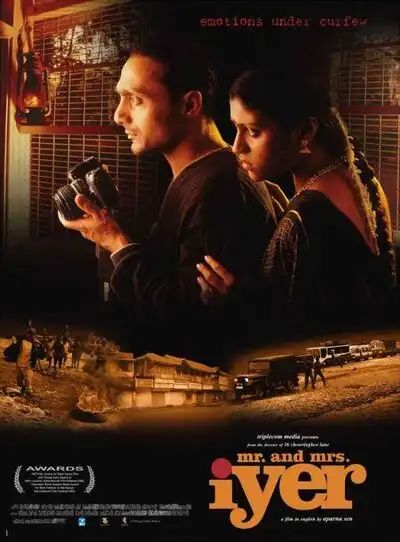
Mr. and Mrs. Iyer is a 2002 Indian English-language drama film written and directed by Aparna Sen and produced by N. Venkatesan.
The title “Mr. and Mrs. Iyer” is not limited to the meaning of a marital relationship. In the film, it becomes a symbol of a false yet necessary identity—where a woman presents an unknown man as her husband in order to save his life. Thus, the title represents safety, a human connection beyond religion, and a temporary identity formed in times of fear—essentially, a new identity created in the name of humanity.
In the film, Meenakshi Iyer, a traditional South Indian woman, is traveling by bus with her infant child. On the same bus is Raja Chowdhury, a photographer. Initially, they are complete strangers, and there is a visible distance between them due to differences in religion and language.
During the journey, sudden communal riots break out outside. The situation becomes extremely dangerous, especially for Raja, as he is Muslim. To save him, Meenakshi takes a brave decision—she claims him to be her husband and introduces him as “Mr. Iyer.”
Because of this false identity, Raja’s life is saved, and during the journey, a subtle emotional and human bond develops between them. However, this relationship is shaped by circumstances—fragile, temporary, and bound by reality.
In the end, when the situation returns to normal, they part ways, but a deep sense of respect and an unspoken connection remains between them.
The central theme of the film is humanity versus communalism. Against the backdrop of riots, two strangers from different religions learn to trust each other. Through fear, identity, and survival-driven decisions, the film reveals the true essence of humanity and highlights how fragile and situation-dependent identity can be.
Aparna Sen’s direction in the film is subtle, realistic, and deeply sensitive. Instead of relying on dramatic moments, she builds tension and emotion through small, quiet moments. The atmosphere—bus journey, silence, and fear—feels so natural that the viewer becomes a part of the experience.
She delicately portrays the conflict between communal hatred and human connection. There are no exaggerated dialogues; the story progresses through expressions, gestures, and silence. Her direction conveys that even in times of fear and division, humanity can survive.
The music, composed by Zakir Hussain, plays a crucial role. For the first time in mainstream cinema, he also lent his voice to a part of a song. His score does not overpower the narrative but subtly enhances tension, silence, and emotional intimacy between the characters. Through minimal, atmospheric sounds, he effectively conveys fear, empathy, and human connection.
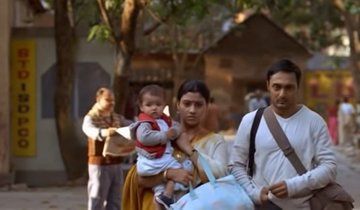
Konkona Sen Sharma delivers a remarkably natural performance as Meenakshi Iyer—she convincingly portrays the journey from a shy, traditional woman to someone capable of making brave decisions.
Rahul Bose is equally effective as Raja Chowdhury, with a calm and restrained performance through which fear and emotional closeness are सहजly conveyed. The chemistry between the two feels highly realistic.
Goutam Ghose’s cinematography adds depth and atmosphere to the film. Through the use of natural lighting, wide landscapes, and close-up shots, he effectively captures both the beauty of the journey and the underlying tension. His camera work subtly conveys the emotional shifts between the characters as well as the fear caused by the riots, making the film more realistic and impactful.
The script is simple and realistic, with minimal yet meaningful dialogue; many emotions are expressed through silence. As a result, even a simple journey conveys a profound message of humanity—that even in times of fear, human compassion endures.
The film premiered at the Locarno International Film Festival and was later screened at several prestigious festivals worldwide. It was released in India on 19 July 2002 and received widespread critical acclaim. The film won several national and international awards, including the Golden Maile Award at the Hawaii International Film Festival and the Nargis Dutt Award at the National Film Awards. While English is the primary language, the film also includes dialogues in Hindi, Tamil, and Bengali, highlighting its cultural diversity.
📸 Photo Courtesy: Google
✍️ Excerpts Source: Google

