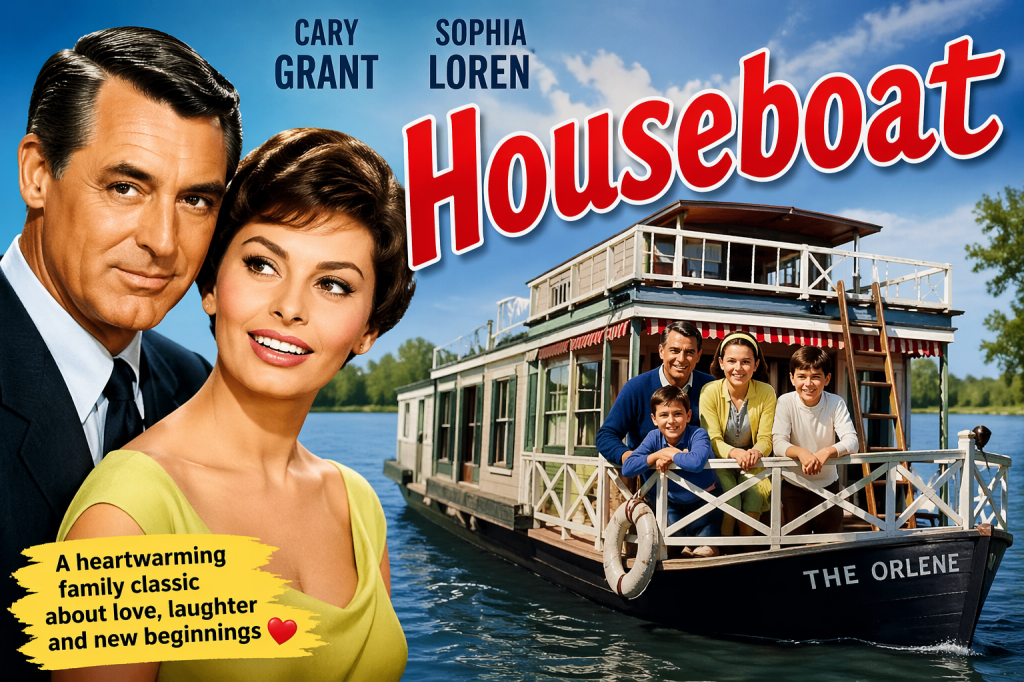
Houseboat is a light-hearted, emotional, and family-oriented film. It is directed by Melville Shavelson, a skilled Hollywood writer and director known especially for family and emotional stories.
“Houseboat” means a home that floats on water — a boat used like a house.
In the film, the hero chooses to live with his children on a houseboat instead of a traditional home. Therefore, the title “Houseboat” does not just refer to a place, but symbolizes change, a new beginning, and the journey of a family coming together again.
Tom Winters, after the death of his wife, brings his three children back home. However, the children are used to living with their grandparents and are not ready to bond with him.
Tom tries to reconnect with them. He takes them to listen to the Boston Symphony, but during the performance, little Robert creates a disturbance by playing his harmonica, leading to an embarrassing situation for Tom. This clearly shows that the distance between father and children has not yet reduced.
Finding it difficult to connect with them, Tom decides to hire a nanny.
Here enters Cinzia — a wealthy Italian girl who is actually seeking independence and chooses to work as a simple nanny. She becomes the caretaker of Tom’s children.
Tom decides to try something different instead of living in a conventional house, and he buys a houseboat. All of them begin living together on this floating home.
At first, life on the boat is difficult — there is little space and many challenges.
But gradually, Tom and the children grow closer. Cinzia bonds well with everyone, and happiness and laughter return to the home. Later, her true identity is revealed, yet she becomes an integral part of the family.
This is a story of rising again after grief, of a family reuniting, and of life changing through love.
Tom’s decision to move into a houseboat shows his desire to leave behind past sorrows and start anew. The initial chaos on the boat reflects both comedy and realism. Cinzia gradually becomes dear to the children, symbolizing love, care, and trust.
When her wealthy background is revealed, it creates some tension, highlighting misunderstanding and truth in relationships.
Eventually, Tom and Cinzia come together, and the family is complete again.
“Almost in Your Arms (Love Song from Houseboat)” is the most famous song, beautifully expressing the love between Tom and Cinzia. It is deeply romantic and emotional.
“Bing! Bang! Bong!” is a light, fun song that captures joyful moments with the children.
Cary Grant delivers a natural and balanced performance as Tom, portraying a grieving yet loving father with ease, blending both comedy and emotion.
Sophia Loren gives a lively and charming performance as Cinzia. She beautifully combines innocence and confidence, and her scenes with the children feel especially warm and heartfelt.

The houseboat sequences in the film feel extremely natural and lively. The gently moving boat on water, limited space, and the movement of the characters create a strong sense of realism in every scene. The riverside locations, open surroundings, and calm visual composition give the film a pleasant and emotionally rich atmosphere.
The houseboat painting scene is one of the most joyful and meaningful moments in the film. As everyone comes together to paint the boat, a lighthearted chaos, laughter, and playful energy fill the scene. This moment beautifully reflects the growing warmth in the family relationships. Painting the boat symbolizes a new beginning, while working together represents the rebuilding of family bonds.
Houseboat received widespread appreciation as an engaging and charming family comedy. Critics praised Cary Grant for his effortless charm, Sophia Loren for her charisma, and the children for their scene-stealing performances. The film is light, entertaining, and enjoyable for audiences of all ages.
📸 Photo credit: Google
✍️ Excerpts: Google

