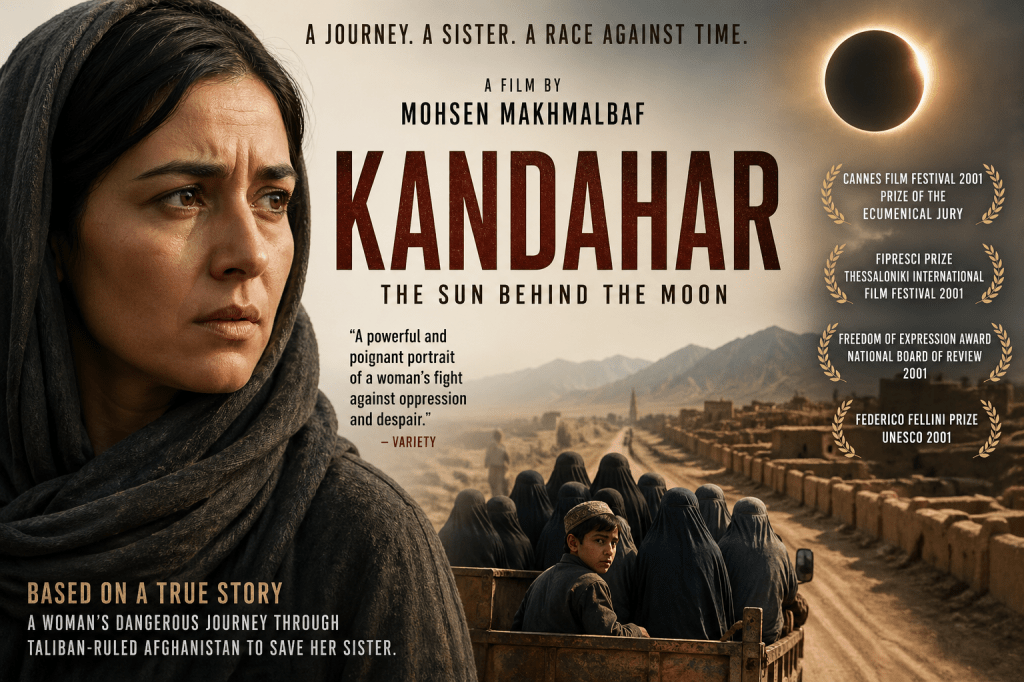
Kandahar, also known as The Sun Behind the Moon, is a 2001 film directed by Mohsen Makhmalbaf. The story is set in Taliban-ruled Afghanistan.
The title “Kandahar” is derived from the important Afghan city of Kandahar. In the film, the journey toward Kandahar becomes a symbol of the protagonist’s personal and emotional struggle. At the same time, Kandahar—depicted as a place affected by war, poverty, and instability—represents human suffering and pain. Her goal of reaching Kandahar symbolizes hope, determination, and purpose. Thus, the title stands as a powerful metaphor for place, journey, and human struggle.
The protagonist, Nafas, is originally from Afghanistan but now lives safely in Canada. One day, she receives a distressing letter from her sister, who writes that due to the Taliban’s oppressive and harsh restrictions on women, she plans to commit suicide on the day of the next solar eclipse.
Shocked by this, Nafas decides to return urgently to Afghanistan to save her sister. With very little time, she undertakes a dangerous journey across difficult terrain to reach Kandahar. Along the way, she meets various people, and through their experiences, the harsh and painful realities of Afghanistan unfold before her.
The film explores several profound themes: the devastation caused by war, the suffering and restrictions faced by women under Taliban rule, and the search for hope even in darkness. The journey itself serves as a strong symbol, reflecting both an outer journey and an inner emotional struggle.
In this film, Mohsen Makhmalbaf takes on the roles of director, writer, and producer. As a director, he establishes the film’s artistic vision; as a writer, he crafts a screenplay partially based on real events; and as a producer, he oversees the entire production process. This makes the project deeply personal and meaningful for him.
As a director, he handles the film with great sensitivity, focusing more on realism than dramatization. Through a simple narrative, he conveys a powerful social message. His direction clearly reflects compassion, empathy, and a strong humanistic perspective.
The role of Nafas is portrayed by Nelofer Pazira, whose performance is natural and compelling. She plays an Afghan-Canadian journalist who travels through Taliban-controlled Afghanistan to save her sister. The role is partly autobiographical, inspired by Pazira’s own real-life experience of returning to Afghanistan in 1996 to search for a childhood friend. Her performance blends personal pain with cinematic expression, giving the film both emotional and social depth.
Many of the film’s actors are non-professionals, which gives it a documentary-like authenticity. Even with minimal dialogue, facial expressions and situations make the performances more powerful.
The cinematography by Ebrahim Ghafouri is simple yet highly effective. The use of desert landscapes, barren surroundings, and natural lighting creates a realistic and slightly somber atmosphere. Long shots and quiet frames emphasize Nafas’s isolation during her journey. The documentary-style visuals intensify both the physical and emotional impact of the film.
Kandahar is not merely a story about saving a sister; it is a vivid portrayal of a war-torn society and a deep exploration of human emotions. Its commentary on war, oppression, and the condition of women is both sensitive and powerful.
The film premiered at the Cannes Film Festival in 2001, where it received critical acclaim. The same year, Mohsen Makhmalbaf was honored with the prestigious Federico Fellini Prize by UNESCO.
In 2001, the film received the Freedom of Expression Award from the National Board of Review, and it was also awarded the Prize of the Ecumenical Jury at Cannes.
Additionally, at the Thessaloniki International Film Festival in 2001, the film won the FIPRESCI Prize, recognizing Makhmalbaf’s “visionary, poetic, yet unflinching portrayal of human suffering in war-torn Afghanistan.”
📸 Photo credit: Google
✍️ Sources: Google

