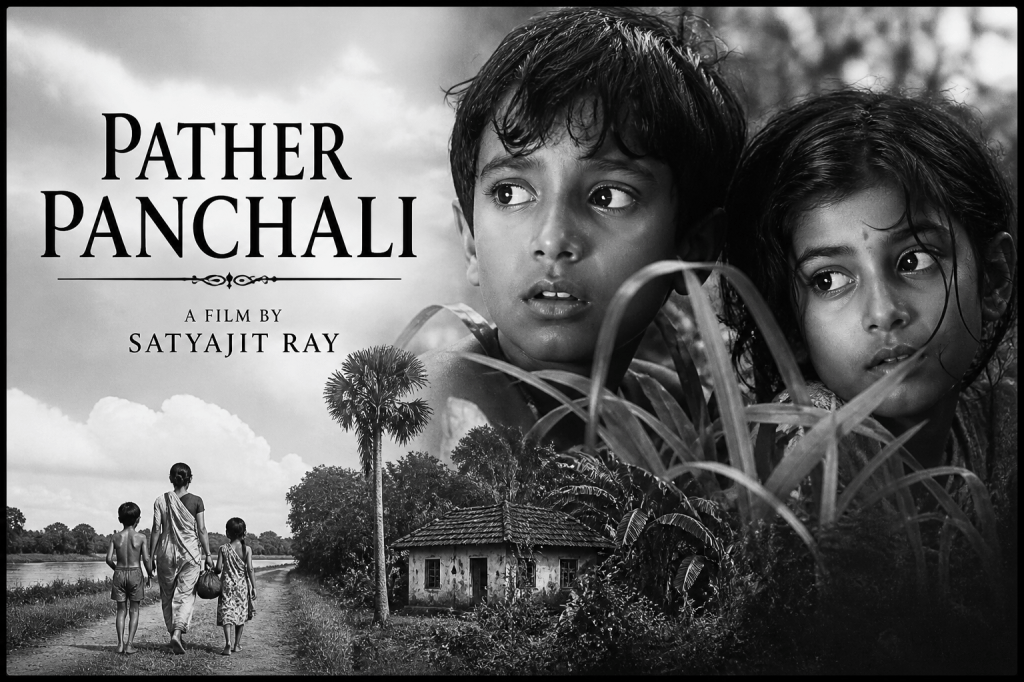
Pather Panchali is directed by Satyajit Ray. His style of direction was realistic and deeply emotional, and he portrayed the stories of ordinary people with great effectiveness. He received the Academy Honorary Award. He was not just a director, but also an excellent storyteller and artist who brought global recognition to Indian cinema.
The Bengali title Pather Panchali—where “Pather” means road and “Panchali” means song—symbolizes the journey of life. It is a touching travel-like narrative of a poor family’s struggle, woven with their small joys and sorrows. The film presents a highly realistic and poetic depiction of simple life in rural Bengal.
The story revolves around a young boy named Apu and his family, who live in poverty in rural Bengal. Along with his sister Durga, mother Sarbajaya, and father Harihar, they lead a very modest life. Harihar, a poet and priest, often stays away for work, leaving the responsibility of the household on Sarbajaya. Apu and Durga spend their childhood playing in nature and finding happiness in little things. However, poverty, illness, and hardship bring sorrow into their lives. Eventually, Durga dies, and the family is forced to leave their village in search of a new life.
The central message of the film is the journey and struggle of life. It sensitively portrays poverty, the innocence of childhood, a deep bond with nature, and experiences of loss, change, and suffering. Yet, even in such circumstances, hope, resilience, and the desire to move forward remain alive—this is the core of the film.
The film beautifully captures the essence of rural Indian life. It does not feature a conventional hero, heroine, or villain—only the struggle of a poor Bengali Brahmin family trying to survive. As the story unfolds, we become emotionally connected to Apu and Durga. Their playful relationship, mutual love, and affection for their family are portrayed with such tenderness that the audience naturally grows fond of them.

Satyajit Ray was truly a magician of filmmaking. Every character reflects the authenticity of village life, offering insight into the hardships of poverty. Technically as well, the film is a major achievement in Indian cinema, with outstanding cinematography and sound design that make it feel vivid and alive.
Musically, Ravi Shankar’s compositions blend beautifully with each scene, enhancing the emotional depth. Pather Panchali is not just a depiction of poverty, but a meditation on life—showing that life continues to move forward despite struggles.
The actors in the film have delivered extremely natural and simple performances. Their acting makes the characters feel real, allowing the audience to experience their emotions closely.
This film is a matter of pride for both Bengalis and Indians. Though there are moments of sorrow, it also highlights the beauty of the world. The elderly grandmother is a particularly memorable character, adding depth and emotional richness to the narrative.
Overall, the film is a beautiful blend of powerful performances, assured direction, and a deeply moving story. Satyajit Ray masterfully captures the simple joys of childhood and the universal dreams of humanity. It is a film worth watching again and again, revealing new meanings with each viewing.
Pather Panchali has won numerous national and international awards. At India’s 3rd National Film Awards in 1955, it was named Best Feature Film and Best Bengali Feature Film. The following year, it competed for the Palme d’Or at the Cannes Film Festival, where it won the Best Human Document award and received a Special Mention from the OCIC (International Catholic Organization for Cinema).
The film was also nominated for Best Film at the 11th British Academy Film Awards in 1958.
📸 Photo credit: Google
✍️ Sources: Google

