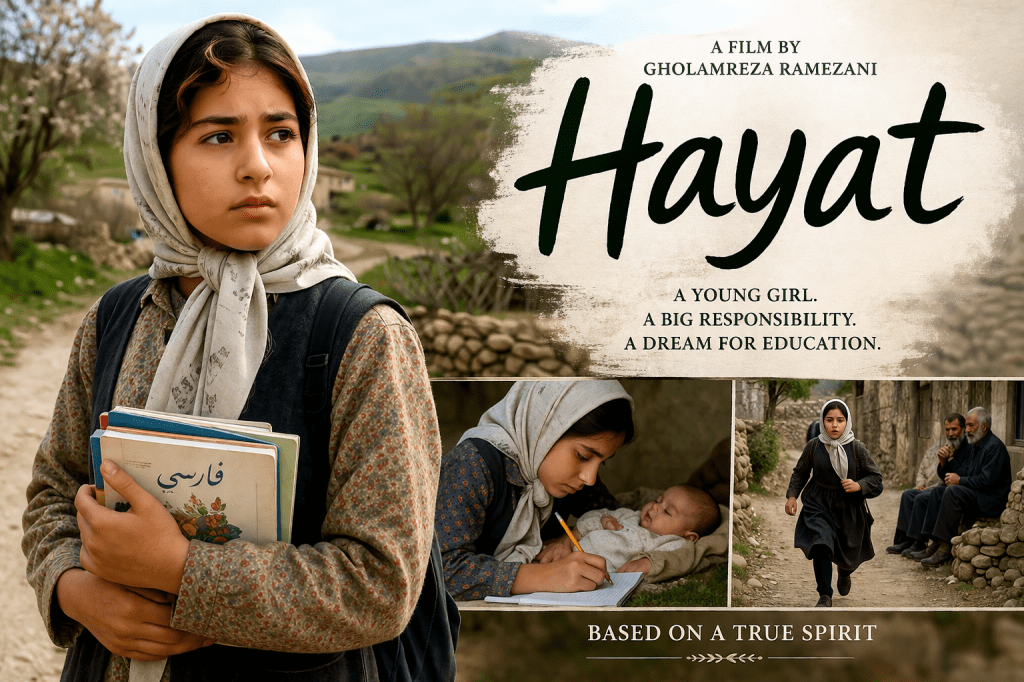
The film “Hayat” is directed by Gholamreza Ramezani, who is known as a sensitive and realistic filmmaker from Iran. His films particularly portray the lives of children, family relationships, and social realities in a deeply effective manner.
The word “Hayat” is Persian and means “life.” In this film, it is not just the name of a girl, but also a symbol of the sudden responsibilities, struggles, and determination that enter her life. Thus, Hayat represents a journey of life that is full of challenges, yet hopeful.
Hayat is a bright 12-year-old girl living in a rural village in Iran. An important school exam is approaching—one that could determine her future education. She studies hard in preparation for it. However, on the night before the exam, her father suddenly falls ill and must be urgently taken to a hospital outside the village. Her mother leaves with her father, but before going, she entrusts Hayat with a major responsibility—taking care of her younger sister.
Now Hayat faces a difficult dilemma: should she stay home to care for her sister, or go to take the most important exam of her life?
She is confronted with a serious challenge—how to balance the need to attend the exam with the responsibility of caring for her younger sister.
Despite these difficulties, Hayat does not give up. The film tells the story of her determination. At the same time, it sheds light on rural life in Iran, the challenges faced by women in a patriarchal society, and the importance of education.
The direction of Gholamreza Ramezani conveys deep meaning through simplicity. He uses a natural and realistic style, where everyday moments are given more importance than grand visuals. In Hayat, he presents the struggle of a 12-year-old girl in a very simple and heart-touching way. He portrays rural Iran in a quiet yet powerful manner. His work shows that even through the eyes of a child, major life themes—such as education, responsibility, and determination—can be expressed effectively.
The story is told in such a light, gentle, and graceful way that the audience easily connects with it; moreover, the film is shot in a real rural village in Iran using natural locations and lighting, and its simple camera style and realistic presentation help viewers connect more closely with Hayat’s journey.
The young girl who plays Hayat delivers an extremely natural and touching performance. She never appears artificial; instead, her expressions clearly convey fear, responsibility, and determination. Especially in scenes where she cares for her younger sister, struggles to reach the exam, and deals with emotional stress, her performance feels honest and effortless.
Because of her acting, the audience becomes deeply connected to her struggle and emotionally invested in every decision she makes.
Hayat’s performance is the soul of the film—simple, real, and deeply moving.
This film was the opening film of the Kinder film fest section at the Berlin International Film Festival in 2005. It received special recognition for its powerful depiction of rural life and the evolving role of women.
📸 Photo credit: Google
✍️ Sources: Google
 Writer Sunita