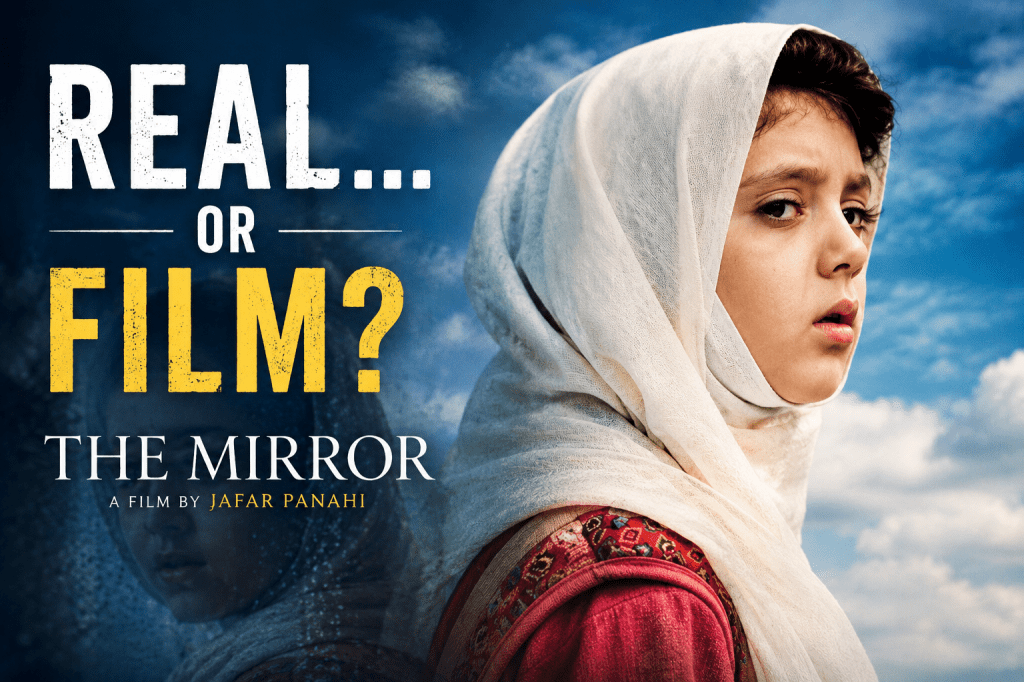
The Mirror is directed by Jafar Panahi, and it is considered a unique and thought-provoking experiment in Iranian cinema.
“The Mirror” symbolizes reflection. But what we see in a mirror is not always the complete truth. Cinema itself works like a mirror—it reflects society, yet it is shaped by the director’s perspective.
Sometimes… is what we see really real? Or is it just a film?
School ends, children go home, but one little girl stands alone. Her name is Mina. She waits for her mother, hoping she will come, but as time passes, she realizes—no one is coming.
Time moves on, the sun begins to set, and finally, she decides to leave on her own. Busy streets, honking cars, unfamiliar faces, and a small girl, searching for her home.
She asks people, “Where is my home?” But no one seems to know. Buses, roads, confusion, and a growing sense of fear. And suddenly, Mina stops.
She looks directly at the camera and says “I don’t want to act anymore.”
At that moment, the story breaks, and reality begins.
We realize—everything we were watching, was a film. Mina removes her microphone and walks away from the set. But the camera continues to follow her. Now there is no script no acting just a little girl and a vast city.
She gets lost again—among people among streets, some help her some ignore her and we can only keep watching.
This film makes us question— what is the difference between reality and cinema? Is what we see truly real?
Mina continues on her path, maybe she will reach home, maybe she won’t, but one thing is certain— this story changes us.
This is not just the story of a little girl, it is the story of the mirror between reality and cinema.
At one point, the film transforms into a “film within a film.” The camera, the director, and the shooting process become visible. The line between “reality” and “performance” blurs, and the viewer is left questioning—
is this real, or still part of the film?
Jafar Panahi’s approach is quiet, subtle, and deeply reflective. While he critiques a patriarchal system, he also appears as a part of it— as he tries to continue the film simply because it has begun. But as the narrative starts to break apart, Mina’s refusal becomes stronger and more meaningful.
Walking away from the camera removing the microphone these actions are not just rejecting a role— they are a rejection of representation itself. Her rebellion may not be entirely conscious, but it feels deeply honest.
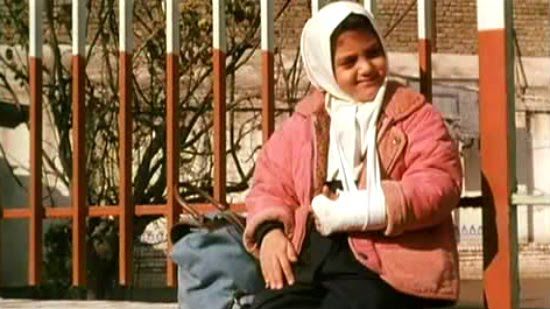
Mina Mohammad Khani delivers a remarkably natural and powerful performance as Mina. Her greatest strength is her simplicity. Her confusion, fear, and curiosity feel completely real. At no point does it feel like acting—
it feels as if she is truly living the moment. She portrays the vulnerability of a lost child in the city with great subtlety.
The most powerful moment is when she looks at the camera and says, “I don’t want to act anymore.” In that instant, the line between acting and reality disappears.
When Mina leaves “acting,” it feels as if we are watching real life through a mirror.
And that is why The Mirror is not just a story about a lost child—it is a film that questions the very nature of cinema itself, and leaves the viewer thinking long after it ends.
The Mirror received significant international acclaim for its innovative storytelling and bold cinematic experimentation. It won the Golden Leopard at the Locarno International Film Festival, one of Europe’s most prestigious honors. At the Istanbul International Film Festival, Jafar Panahi was awarded the Golden Tulip, recognizing his exceptional direction. The film also earned Panahi the Silver Screen Award for Best Asian Director at the Singapore International Film Festival, further cementing his status as a leading voice in world cinema. Additionally, The Mirror was nominated for the Golden Spike at the Valladolid International Film Festival in Spain, underscoring its global resonance and artistic significance.
📸 Photo Courtesy: Google
✍️ Excerpts Source: Google

