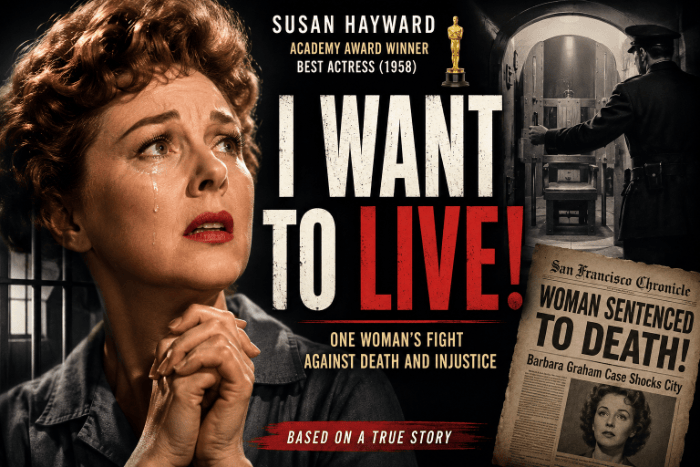
I Want to Live! is a 1958 American biographical film noir drama directed by Robert Wise, starring Susan Hayward in the lead role.
It is a story about justice, the death penalty, the power of the media, and one woman’s desperate struggle to survive until her very last moment.
This is the story of a woman named Barbara Graham.
Barbara Graham’s life was troubled from the very beginning. She became involved with the criminal world. Petty crimes, lies, and associations with the wrong people had already damaged her reputation in the eyes of society.
But there was another side to Barbara’s life. She was a mother. She loved music and poetry.
And that raises an important question… Can a person truly be defined only by her past?
This is one of the central questions at the heart of I Want to Live!
But one night, a murder changes Barbara’s entire life. In 1953, an elderly woman named Mabel Monahan is murdered in her own home. As the investigation begins, the police turn their attention to Barbara Graham and some of her associates.
Barbara insists that she had nothing to do with the murder.
But there was a problem… For the police, her troubled past was enough to make her a suspect. Details of her earlier crimes come to light. Witnesses testify against her, and gradually, the evidence seems to close in around Barbara.
Now only one question remains— Was Barbara really a murderer? Or had society already judged her because of her bad reputation?
And as I Want to Live! tries to find the answer to that question, it takes us inside the courtroom. The trial against Barbara begins.
Inside the courtroom, one chapter after another from her troubled past is revealed. Her previous mistakes, her connections to the criminal world, and the testimony against her all weaken her defense.
But one journalist begins looking at the case from a different perspective. His name is Ed Montgomery. At first, Montgomery writes harshly about Barbara. But gradually, he begins to investigate the case more deeply. And he realizes that there are still questions that remain unanswered.
Was Barbara really involved in the murder?
Or had she been trapped by circumstances, questionable testimony, and the reputation she had built in the past? But by then, it is too late.
The court finds Barbara guilty. And she is sentenced to… death.
Now Barbara faces prison walls, a date with death, and very little time left to save herself. Until now, she had been fighting the world… But now, her battle is with death itself.
Every day on Death Row feels like one more step toward death. There is still hope that her lawyers can appeal the sentence, but with every failed attempt, that hope begins to fade.
Outwardly, she tries to remain strong. But inside, she is terrified. Because death is no longer simply a sentence handed down by the court…
It is getting closer to her with every passing moment. And yet, Barbara continues to fight to save herself until the very end. Because no matter how tough a person may be, no matter how many mistakes they may have made… when death stands before you, the desire to live becomes stronger than anything else.
And this is where Susan Hayward’s performance truly breaks your heart.
From Barbara’s carefree, aggressive and confident personality at the beginning, to the frightened and helpless woman trapped in the shadow of death, Hayward portrays her emotional transformation with extraordinary power.
Her fear, helplessness, regret, and desperate desire to live until the very last moment can be felt in every expression.
Barbara stops being merely a character on the screen. She becomes a helpless human being living right before our eyes.
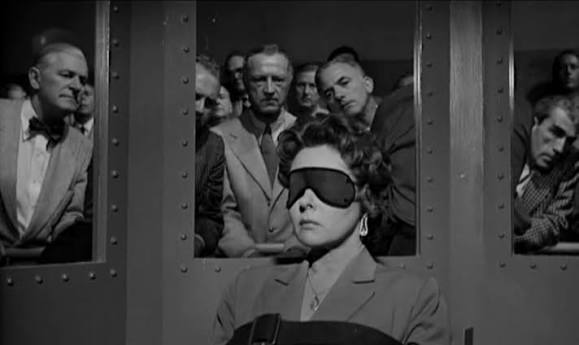
And then comes that moment… Barbara is taken to the gas chamber at San Quentin. Her eyes are blindfolded. She knows exactly what awaits her. Death is only moments away. And yet… she struggles to live until the very last second. But now, her time has run out.
Robert Wise presents this sequence without turning it into sensational drama. Instead, he makes it deeply realistic. To give the scene a sense of authenticity, Wise drew upon firsthand exposure to an actual execution.
And because of that, the ending of I Want to Live! becomes more than just the death of one woman.
It leaves the audience with a deeply disturbing question— When we sentence someone to death, can we ever be completely certain that we have found the truth?
But the real question of this film is even bigger than whether Barbara was innocent. Can a person’s mistakes become their entire identity?
A person may have a troubled past… She may have made terrible mistakes…
But does that mean she no longer deserves to be heard? I Want to Live! forces us to think about exactly that.
Susan Hayward did not simply play Barbara Graham. Through her performance, she brought Barbara’s fear, helplessness, regret, and desperate desire to live vividly to the screen.
It became one of the most powerful performances of her career. For this role, Susan Hayward won the Academy Award for Best Actress. And that is why I Want to Live! remains an important milestone in her career.
But the true power of this film does not lie in the award. It lies in the question it leaves behind. Justice is not merely about punishment… it is also about finding the truth.
And that is why… “I Want to Live!” is more than just the title of a film.
It is Barbara’s cry until the very last moment— “I want to live…”
But sometimes, a person’s greatest desire becomes their final cry.
📸 Photo Courtesy: Google
✍️ Excerpts: Google

