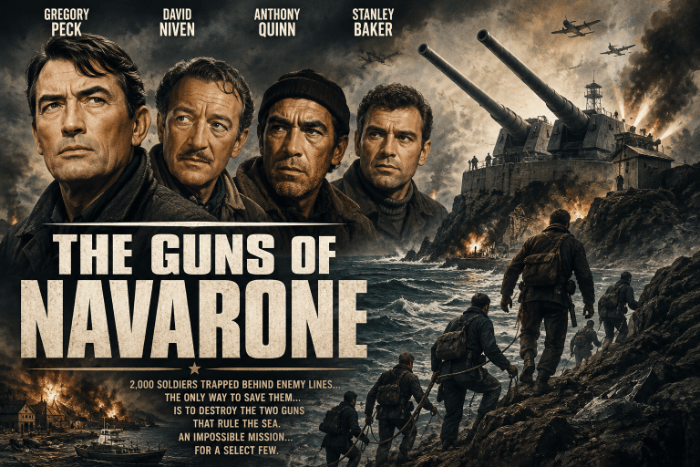
The Guns of Navarone (1961) is the most unforgettable war films in cinema history directed by J. Lee Thompson and written and produced by Carl Foreman.
The story is set during the final stages of the Second World War.
In 1943, around two thousand British soldiers are trapped by German forces on the island of Keros in the Aegean Sea. The Royal Navy must help rescue them, but two massive radar-controlled German guns on the island of Navarone block the path of British warships.
These guns are so powerful that any warship approaching them is destroyed within moments. Air strikes to eliminate them have also failed, leaving the British command with only one option: to launch a daring mission to destroy the guns from within. Time is running out, and the stakes are higher than ever.
Time is running out. The British command has only one option left… to destroy these guns from within.
For this mission, a special commando team of six men is selected. The team is led by Captain Keith Mallory, an experienced mountaineer and officer. Accompanying him are Miller, an explosives expert; Andrea, a brave but hot-tempered soldier; Brown, an expert in espionage; Franklin, an engineer; and a few other selected soldiers.
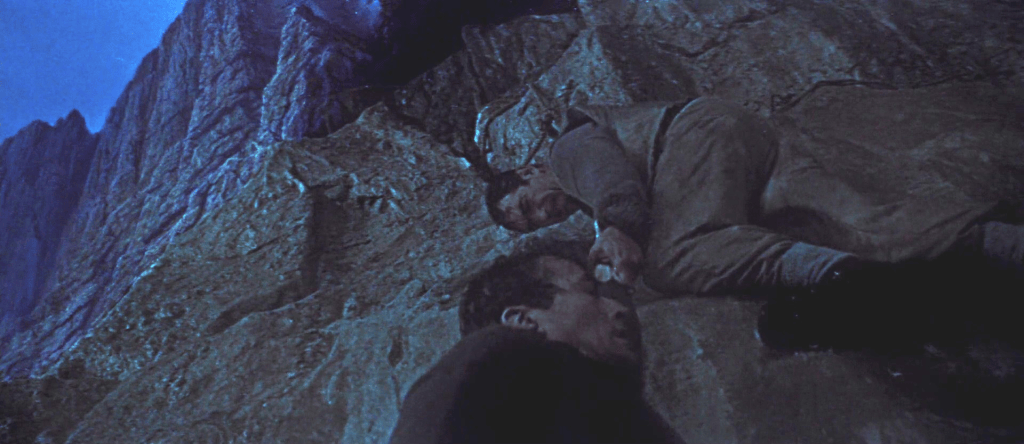
Their first challenge is to reach the island of Navarone secretly by sea. However, a violent storm destroys their boat, leaving several men injured. Yet, abandoning the mission is not an option. They manage to enter the island by climbing a steep, rugged cliff that seems almost impossible to scale.
As their journey progresses, they face German patrols, constant life-threatening pursuits, and a shortage of food and water. Death seems to follow them at every step.
During the mission, they encounter two women from the Greek resistance movement, who offer to help them.
But trusting everyone can be dangerous. Soon, the team discovers that someone among them is secretly passing information to the Germans.
Now, a bigger question arises… Who is the traitor?
Betrayal, suspicion, and ever-increasing danger create tension within the team.
One by one, their fellow soldiers lose their lives. Yet, the remaining members continue their mission without giving up.
Finally, they succeed in entering the fortress of Navarone. But their greatest challenge still lies ahead…
They must reach the massive guns and destroy them. Time is running out, and German forces are closing in on them.
The fate of thousands of soldiers now depends on the courage of just a handful of men.
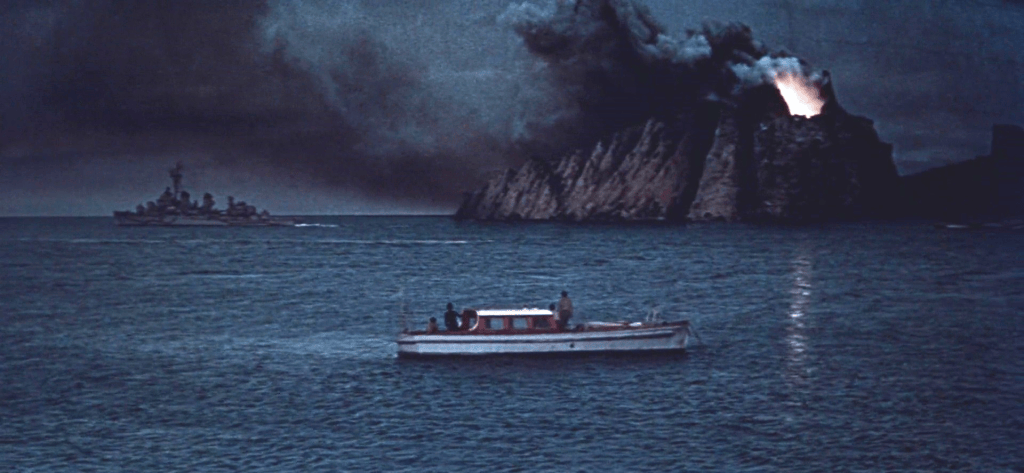
After an extremely tense struggle, they finally succeed in planting the explosives. A massive explosion follows… and the mighty guns of Navarone are destroyed forever.
The sea route is now clear. Help finally arrives… and thousands of soldiers are saved.
But this victory comes at a heavy cost. Many brave soldiers make the ultimate sacrifice.
The Guns of Navarone opens with a grand, legendary atmosphere. James Robertson Justice’s narration and Dimitri Tiomkin’s powerful score give the mission the epic quality of a Greek mythological adventure. Tiomkin’s magnificent orchestration, suspense-building compositions, and restrained melodies in emotional scenes make the film even more impactful. Particularly, the music leading up to the final explosion heightens the tension and excitement.
The Guns of Navarone is not just a war film; it is a story of courage, friendship, sacrifice, and men who believe in accomplishing what seems impossible. The dangerous journey through enemy territory, the challenges at every step, and the struggle to complete an almost impossible mission through courage, careful planning, quick thinking, and mutual trust keep the audience engrossed until the very end.
The film is directed by J. Lee Thompson, who has handled the war sequences, adventurous moments, and emotional conflicts between the characters with great skill and balance. The massive guns, the magnificent fortress sets, and the storm scenes at sea are particularly impressive. The use of actual locations and elaborate sets makes the adventurous sequences feel even more realistic.
Gregory Peck delivers a deeply moving performance, portraying the burden of leadership and difficult decisions. David Niven subtly captures Miller’s skeptical yet principled nature, while Anthony Quinn brings strength and intensity to his role. Anthony Quayle effectively portrays the conflict between despair and pride, and Stanley Baker realistically conveys the psychological strain of war. James Darren brings passion and boldness to the resistance fighter, while Irene Papas beautifully expresses pain, love, and duty. Gia Scala adds depth to the betrayal storyline, and Richard Harris convincingly portrays the frustration of the failed air mission.
With its thrilling action, steadily building suspense, and beautiful blend of human emotions, the film continues to be regarded as one of the finest war movies ever made.
At the 34th Academy Awards, the film received nominations in six categories. It went on to win the Oscar for Best Special Effects.
Harrison’s Reports rated the film “Excellent,” praising its screenplay, direction, performances, and cinematography.
The Washington Post described it as a spectacular and thrilling adventure, highlighting the breathtaking depiction of the Greek islands.
The Los Angeles Times called it the best adventure film of the year.
📸 Photo courtesy: Google ✍️ Sources: Google

